

A local citation is any online mention of your business name, address and phone number (NAP). Think of your Google Business Profile, your Yelp page, a listing in your chamber of commerce directory, or a local news story that names your shop. Citations help Google and other platforms confirm that your business is real, where it is and what it does.
Do they still move rankings? Yes, but not the way they did ten years ago. Building 300 directory listings won’t push you into the map pack on its own. Getting your core listings accurate, then earning mentions on sites people actually read, still pays off. And with AI tools like ChatGPT and Google AI Overviews pulling local recommendations from third-party sites, the right citations matter more than they did a couple of years ago.
Here’s how I approach citations for local clients today.
What counts as a local citation?
Any page that mentions your business can count. A full citation shows your name, address and phone number. A partial citation might show only your name and city, or your name and phone number. A link back to your site is a bonus, not a requirement. Whitespark, one of the most-cited sources on this topic, puts it simply: the value is in the mention itself.
Citations come in two main types.
Structured citations
These are listings on directories and platforms with fixed fields: business name, address, phone, website, hours, categories, photos. Google Business Profile, Bing Places, Apple Business Connect, Yelp, Facebook and industry directories like Avvo or Houzz are all structured citations. Your Google Business Profile is the most important one you have.
Unstructured citations
These are mentions in normal content: a local news article, a blog post, a “best of” list, an event page, a podcast show notes page. There’s no form to fill in, so you can’t just submit them. You earn them through PR, partnerships, sponsorships and doing things worth writing about.
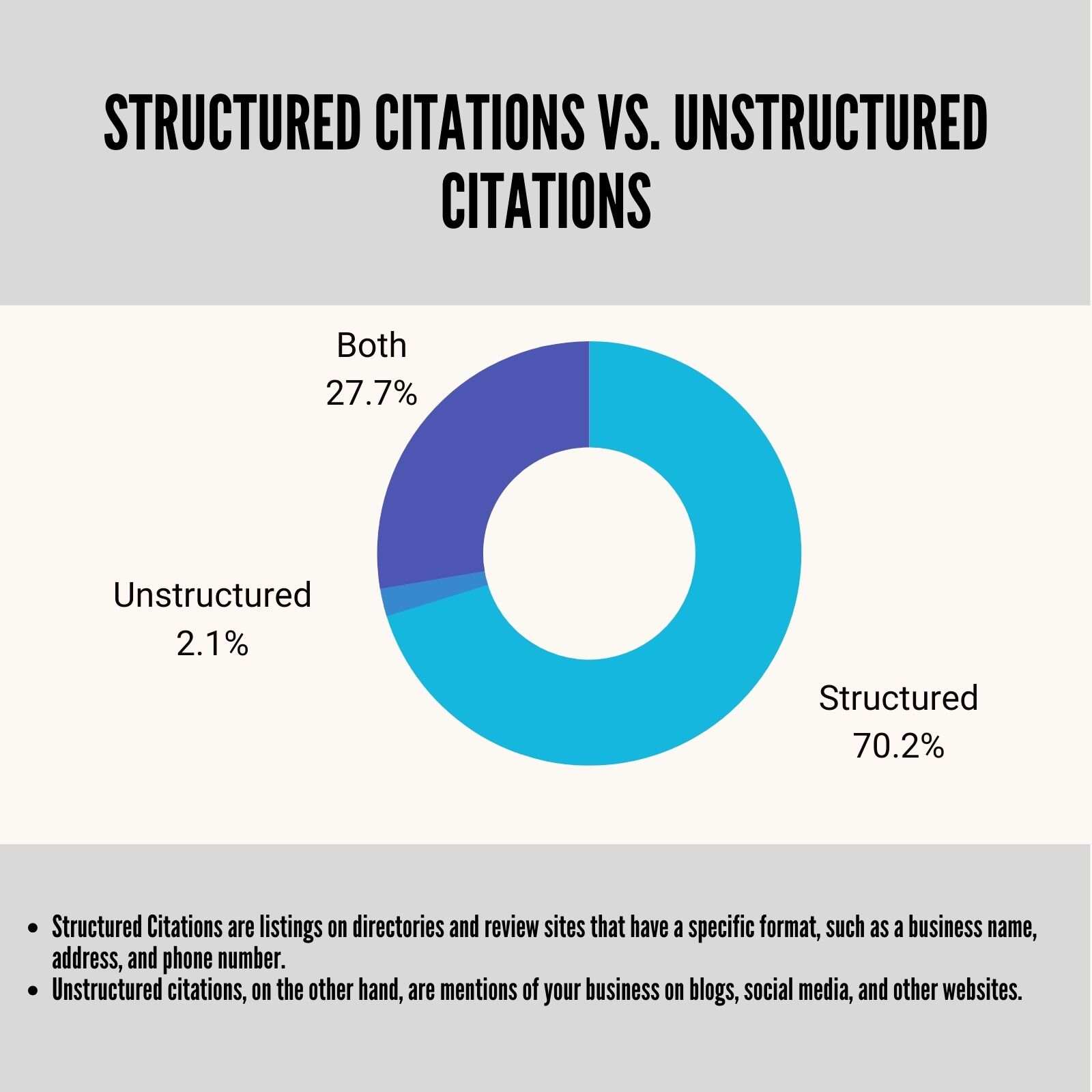
Structured vs unstructured citations at a glance
| Structured citations | Unstructured citations | |
|---|---|---|
| Where they live | Directories, maps apps, review sites | News sites, blogs, best-of lists, event pages |
| Format | Fixed fields (name, address, phone, hours, category) | Free text inside an article or post |
| How you get them | Claim or submit the listing yourself | Earn them through PR, outreach and partnerships |
| You control the details? | Mostly, once the listing is claimed | No, the publisher writes it |
| Main job | Confirm your NAP and categories | Build prominence and trust |
| Examples | Google Business Profile, Bing Places, Apple Business Connect, Yelp | Local newspaper feature, “best cafes in Austin” list, supplier blog |
How citations affect local SEO
Google says local results are based on three things: relevance, distance and prominence. Prominence is how well known a business is, and Google lists info like how many websites link to your business and how many reviews you have as part of it. Citations feed into that picture in three ways.
- They confirm your details. When your name, address and phone match across trusted sources, Google has less reason to doubt your Business Profile.
- They send real customers. People still find businesses on Yelp, Apple Maps, Bing and niche directories. A wrong phone number there costs you calls, rankings aside.
- They feed AI answers. AI search tools lean on third-party sources when they recommend local businesses. Whitespark’s 2026 citation playbook found local SEOs rank presence on expert “best of” lists as the top factor for AI visibility, with unstructured citations close behind.
Here’s the honest part. For classic map pack rankings, citations are now a supporting signal. Your Business Profile, reviews, website content and links usually do more of the heavy lifting. Citations are the foundation. Get them right, then move on.
Citations also tie into how Google understands your business as an entity. If that idea is new to you, my guide to local entities for SEO explains it in plain terms.
Why NAP consistency still matters
NAP stands for name, address and phone number. If your business moved two years ago and half your listings still show the old address, you’re sending mixed signals to search engines and to customers.
Small formatting differences aren’t a problem. Google knows “St.” and “Street” are the same thing. What hurts is real conflict:
- An old address or a closed location still listed
- Two different phone numbers, or a tracking number on some sites and your main line on others
- Duplicate listings for the same business on one platform
- A different business name, like an old brand name or a name stuffed with keywords
Pick one exact version of your name, address and phone number. Use it on your website, your Business Profile and every listing you control.
How to build and clean up local citations
This is the order I work in. It puts effort where customers and search engines actually look.
- Lock down the big platforms. Claim and complete Google Business Profile, Bing Places, Apple Business Connect, Facebook and Yelp. Fill in every field, including categories, hours, services and a clear description.
- Audit what’s already out there. Search for your business name, old addresses and old phone numbers. Tools like BrightLocal’s Citation Tracker or Whitespark’s Local Citation Finder speed this up.
- Fix or remove the bad ones. Correct wrong details, merge or remove duplicates, and update anything with an old address. Start with the sites that rank in Google for your brand name.
- Submit to the data aggregators. In the US, Data Axle, Foursquare and Localeze supply business data to many smaller sites. Getting these right stops old data from spreading back out.
- Add industry and city directories. A lawyer needs Avvo and Justia. A contractor needs Houzz and Angi. Your local chamber of commerce and city business directories belong here too.
- Earn unstructured mentions. Sponsor a local event, get quoted in local news, team up with nearby businesses, and pitch yourself for local “best of” lists. This is the slow part, and it’s where most of the upside is now.
Once you have your core 30 to 50 quality listings, stop. Hundreds of low-quality directories add little and take time to maintain. If you work with a subscription listing service, check what happens to your listings if you ever cancel.
If you serve several towns, map out which service and city combinations you want to show up for before you write listing descriptions. My service area keyword builder does this in a minute.
Common citation mistakes I see
- Buying bulk citation packages. Hundreds of listings on sites nobody visits rarely help and can spread inconsistent data.
- Using a call tracking number everywhere. If you track calls, keep your main number as the primary on your Business Profile and core listings.
- Forgetting old locations. After a move, the old address keeps showing up for years unless you hunt it down.
- Keyword stuffing the business name. “Smith Plumbing Best Plumber Dallas” breaks Google’s guidelines and creates a name mismatch everywhere else.
- Set and forget. Directories pull data from each other and from aggregators. Check your core listings a few times a year.
FAQ
Do local citations still help SEO?
Yes. Accurate citations on major and industry platforms support your Google Business Profile and send real customers your way. They’re no longer a shortcut to the map pack, but missing or wrong citations can hold you back, and mentions on trusted sites help with AI search visibility.
How many citations does a local business need?
There’s no magic number. Most small businesses do well with their core platforms, the main data aggregators, and the top directories for their industry and city. That usually lands somewhere around 30 to 50 quality listings. After that, earned mentions matter more than more directories.
Are citations the same as backlinks?
No. A citation is a mention of your business details. A backlink is a link from another site to yours. A citation can include a link, but it still counts as a citation without one.
How long do citations take to have an effect?
New listings can take weeks to be picked up and months to show any effect on rankings. Fixes to the big platforms like Google, Bing and Apple show up faster than changes on small directories.
Should I use a citation building service?
It can save time, especially for cleanup across many sites. Choose one that lets you keep control of the listings, and skip anyone selling hundreds of low-quality directories.
Need a hand with your citations?
Citation cleanup is part of every local SEO project I take on, alongside Business Profile work, reviews and on-site content. If you want to see what better local visibility could be worth to your business, try the local SEO ROI calculator. Or get in touch and I’ll take a look at your listings.