

An online paystub generator is a small SaaS product with a big search problem. The head terms are crowded, the niche touches people’s money, and some of the traffic wants something you should never sell. This is the SEO strategy I’d use for a paystub generator today, shaped by my work on Stubs On Demand, a US paystub generator I helped rebuild visibility for after its relaunch.
The short version: map keywords to buyer intent, build trust before you build links, win the bottom of the funnel with use-case and comparison pages, and keep everything honest. Here’s how each piece works.
What is a paystub generator?
A paystub (also called a pay stub, check stub or pay slip) is the record of one pay period: gross pay, taxes and other deductions, net pay and year-to-date totals. A paystub generator is a web app that calculates those figures and produces a stub, usually as a PDF. Its main users are small employers, contractors and self-employed people who don’t run a full payroll system.
It’s SaaS in the usual sense. The provider hosts it, people use it in the browser, and there’s nothing to install. That matters for SEO because your website is your product, your sign-up flow and your main acquisition channel all at once.
One fact worth putting on your site early: the federal Fair Labor Standards Act doesn’t require employers to provide pay stubs, but many states have their own pay statement rules. People search for exactly that, and a clear, accurate answer builds trust.
Why paystub generator SEO is harder than it looks
- It’s a YMYL niche. Paystubs get used for loans, rentals and taxes, so Google expects a high bar for accuracy and trust. If that’s new to you, start with my guide to E-E-A-T and YMYL in SEO.
- Some demand is toxic. Searches like “fake paystub generator” exist. Don’t target them. Landlords and lenders screen income documents for fraud, and a brand tied to fake documents is a brand nobody trusts.
- The head terms are crowded. Big payroll brands and dozens of generators chase the same handful of phrases, and paid search competition is fierce.
1. Build a keyword map around intent
Start with a keyword tool (I use Ubersuggest alongside Google Search Console) and pull every variation of the core term. Then sort by what the searcher wants to do, not just by volume.
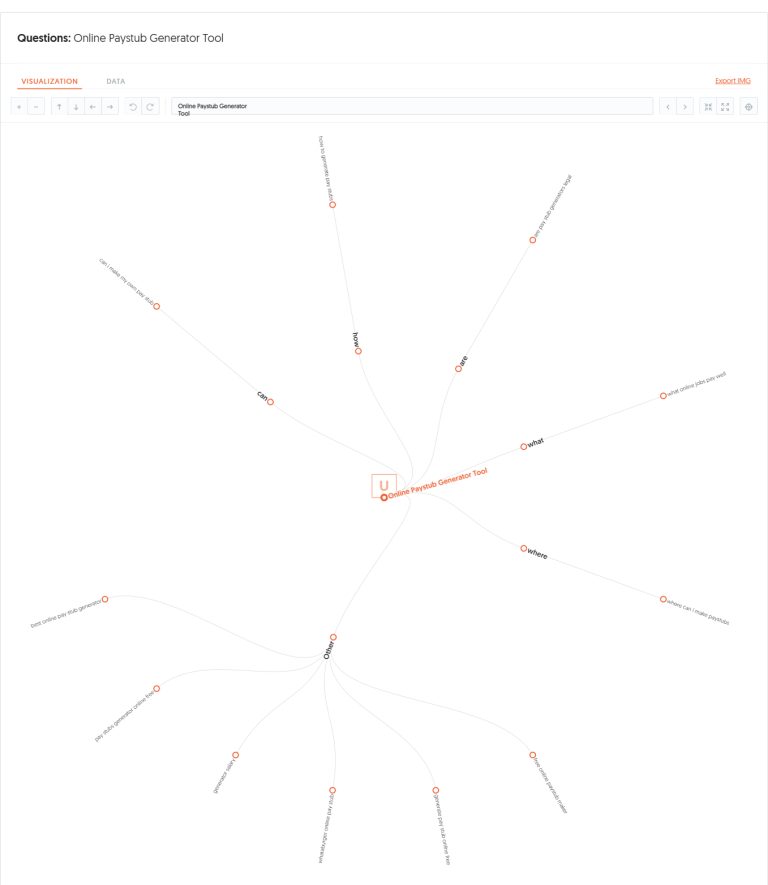
Ubersuggest’s US data (October 2026) puts “paystub generator” at around 27,100 searches a month, with “free paystub generator” and “paystub generator online” close behind. The long tail is where a newer site can win: modifiers like 1099, self-employed, with taxes, with YTD and no watermark, plus state names like California and Texas.
| Stage | Example searches | Page to build |
|---|---|---|
| Awareness | what is a pay stub, are pay stubs required by law, how to read a pay stub | Guides and state pay stub explainers |
| Consideration | paystub generator for self employed, 1099 paystub generator, paystub generator with taxes | Use-case landing pages |
| Decision | best paystub generator, legit paystub generator, [competitor] paystub generator | Comparison and alternative pages, the tool page |
Give each keyword group one page. If two pages chase the same phrase, merge them.
2. Make the tool page your strongest page
For a SaaS tool, the money page is the generator itself. Searchers want to make a stub, so let them start right away, above the fold, without a forced sign-up before they see the form.
- Use the main keyword in the title tag, the H1 and the first line of copy, naturally.
- Add short, accurate copy below the tool: what’s on the stub, which taxes it calculates, which states it supports and how user data is protected.
- Show a sample stub so people know what they’ll get.
- Answer common objections in an FAQ: watermarks, corrections, YTD figures and contractor stubs.
3. Fix the technical basics
Most paystub generators run on Laravel, Node.js or a site builder with a JavaScript form. Make sure Google can render your important content without user interaction, that the form doesn’t slow the page down on mobile, and that sign-up and checkout pages stay out of the index. A technical SEO audit catches most of this in one pass, and the page speed impact tool shows what slow pages cost you.
4. Build use-case and state pages carefully
Use-case pages (self-employed, 1099 contractors, small businesses, household employers) and state pages (California, New York, Texas) match real long-tail demand. They can also go badly wrong. Google’s spam policies treat mass-produced pages that only swap a keyword as scaled content abuse.
The test is simple: does each page say something the others don’t? A state page should cover that state’s pay statement rules and whether it has a state income tax. A self-employed page should explain how a stub works when you pay yourself. If you can’t add something specific, don’t publish the page.
5. Win the decision stage with comparison pages
People who search a competitor’s name plus “paystub generator”, or look for the best or most legit option, are close to buying. Honest comparison and alternative pages work well here: what each tool does, who it suits, and where yours is the better fit. Keep every claim factual and current. Exaggerated comparisons hurt trust in a YMYL niche faster than anywhere else.
These pages also get picked up by AI search tools, because they answer a direct question in a format that’s easy to quote.
6. Organize content into topic clusters
Choose the broadest term as your pillar (the generator page or a main pay stub guide) and link supporting articles to it: how to read a stub, what YTD means, pay stub rules by state, stubs for contractors. Link from the pillar back to each one. This makes the site easier to crawl and shows Google you cover the topic in depth. A content SEO plan keeps the cluster from drifting into random blog posts.
7. Run a keyword gap analysis
Compare the keywords your top competitors rank for with your own. Look for terms where two or three competitors rank and you don’t. Those are your next pages. Ubersuggest, Semrush and Ahrefs all have a competitor or gap report for this.
8. Earn links and listings that build trust
List the product on software directories like G2, Capterra and Product Hunt. They send referral visits and give buyers a place to read reviews. Past that, the best links in this niche come from useful assets: a pay stub rules by state resource, a free paycheck calculator, or original guides that small business and HR sites want to cite. Skyscraper link building works well for this, and a link building campaign can scale it.
Skip paid link packages and link schemes. In a YMYL niche, a spammy link profile is a bigger risk than a slow site.
9. Show who stands behind the product
Trust signals count for more here than in most SaaS niches. Add a real About page with your company name and contact details, a privacy policy that explains how employee data is stored, tax calculation notes with a “last updated” date, and genuine customer reviews. Make it clear in your terms that the tool is for real earnings records only. Google’s guide to helpful, reliable, people-first content makes a good checklist.
10. Measure what matters
Track impressions and clicks in Search Console, rankings for your mapped keywords and, most of all, sign-ups and paid stubs from organic visits. On Stubs On Demand we tracked progress in Search Console, Semrush and Ubersuggest. Between August 2021 and March 2022 the site earned 233K impressions and 1.15K clicks, and impressions kept climbing as new content got indexed.
If you’re weighing up doing this in-house or hiring help, the SEO cost calculator gives you a starting point.
FAQ
How long does SEO take for a paystub generator?
Think months, not weeks. Long-tail and use-case pages usually move first. Competitive terms like “paystub generator” take longer and need strong content and links together.
Should a paystub generator target “free” keywords?
Only if you offer something free, such as a free preview, a free calculator or a free first stub. Ranking a paid-only tool for “free paystub generator” just brings bounces and annoyed users.
Are pay stubs legally required?
Not under federal law. The FLSA doesn’t require them, but many states set their own pay statement rules. Check your state labor department for the details.
Is paid search worth it for a paystub generator?
It’s useful for testing which keywords convert, but clicks in this niche are expensive. Use the paid data to decide which organic pages to build first.
Do software directories help SEO?
Mostly indirectly. Listings on G2, Capterra and Product Hunt bring referral visits and reviews that build trust. Many of their links are nofollow, so don’t count on them alone for rankings.
Want help with your SaaS SEO?
If you run a paystub generator or another small SaaS tool and want a plan built around your real keywords, get in touch.